
Thailand’s 60-day visa-free entry for Indian passport holders is ending. I made good use of the facility a few months ago when I spent seven weeks in my favourite country. By the end of my stay, I realised I wanted to stay longer in Thailand than the usual tourist visas allow. So I applied for a Destination Thailand Visa, or DTV, as it is commonly known.
DTV requires you to have your income from outside of Thailand. You cannot do business in the country on this visa. And it’s difficult to open a local bank account with this visa.
If you are staying in Thailand for less than 182 days in a calendar year, you do not need to pay tax in the country. For stays longer than 182 days, you may be liable for tax, but from what I understand, it depends on your individual income scenario. But I will not elaborate on things that aren’t officially declared. From my end, I didn’t look much into this since I do not intend to spend more than six months a year in Thailand.
Launched in 2024, this visa is issued under three categories.
First, Workcation (digital nomad/remote worker/foreign talent/freelancer).
Second, Thai soft power-related activities (e.g., Muay Thai, Thai culinary training, and medical treatment).
And finally, Spouse and children under 20 years old of DTV visa holders.
In this piece, I am going to focus on the first category based on my experience of applying and getting a DTV as a freelance remote worker.
This is a multiple-entry visa issued for a period of five years, and each entry allows a six-month stay.
The required documents for an application under the Workation category listed on the official website are:
- Biodata page of Passport or Travel Document [I scanned the page on my phone and uploaded]
- Photograph taken within the last six months [I followed the official guidelines and took a selfie on my phone. It worked perfectly]
- Document indicating current location (e.g., valid visa, receipt(s)/proof(s) of payment of airline tickets or accommodation, etc.) [I bought a ticket from my location in India to Bangkok and attached it as proof]
- Financial evidence: an amount of no less than 500,000 THB, (e.g., bank statements for the last three months, sponsor letter) [I attached my account statement with the required funds]
- Employment contract or employment certificate in their country or professional portfolio showcasing digital nomad, remote worker, foreign talent or freelancer status [I submitted two contracts with companies I was working with. I merged them into a single PDF before uploading. Probably a bit of an overkill. One should be fine]
What you need to do first is go to the Thai e-Visa Official Website and create an account. Then, you fill out the online form. You need to mention a local phone number and address, and I provided a friend’s address and number.
The DTV application fee is INR 25,000 (April 2026), which was a surprise for me because when I was researching the visa earlier, it had mentioned THB 10,000, and THB/INR had long since crossed 2.5. But when I tried paying, I realsed I couldn’t make the payment online. I’m not sure if this is unique to the consulate I was applying to (Kolkata) of all consulates in India, but I either had to go to the consulate and pay via demand draft, or make the payment in cash at a DBS Bank branch.
In case of payment at DBS, I’d have to send the payment info summary generated at the end of the application (with a QR code) and the deposit slip via email to thaivisa.ccu@gmail.com. This is what I did.
Two days later, I received an email from the embassy requesting the following additional documents.
- A request letter from the company to the Thai Consulate for visa issuance.
- Proof/evidence of long-term accommodation in Thailand.
- Please provide a reason for your visa request that you need to be in Thailand.
The email also explained how I could add these to my application on the portal.
I requested such a letter from one of the companies I work with, and they were happy to issue one. In fact, the company largely followed a template I provided them. Here’s the template in case you want to replicate it on a company letterhead:
*****
Date
The Royal Thai Consulate-General,
Kolkata, India.
Subject: Employment Verification and No Objection for Travel
Firstname Lastname (Indian Passport No.XXXXXX) has been a contractor with Company Name since Month Year. We have no objection to him working from Thailand, and request that you grant him a visa.
Sincerely,
Company Representative Signature
Company Name
Company email and phone
*****
To satisfy a long-term accommodation requirement, I booked a three-month stay and attached the booking confirmation.
The third request was a cover letter. I wrote honestly that I loved the country, and I now had friends and a community there, which is why I wanted to spend more time in Thailand. And since I met all the DTV requirements, I had decided to apply. I also mentioned that my intention was to initially stay with a friend (I mentioned the friend’s name and address) and look for a house, since I would want to physically check out a house before leasing one. I also wrote that I was attaching a three-month booking confirmation only to meet the requirements.
That’s all it took.
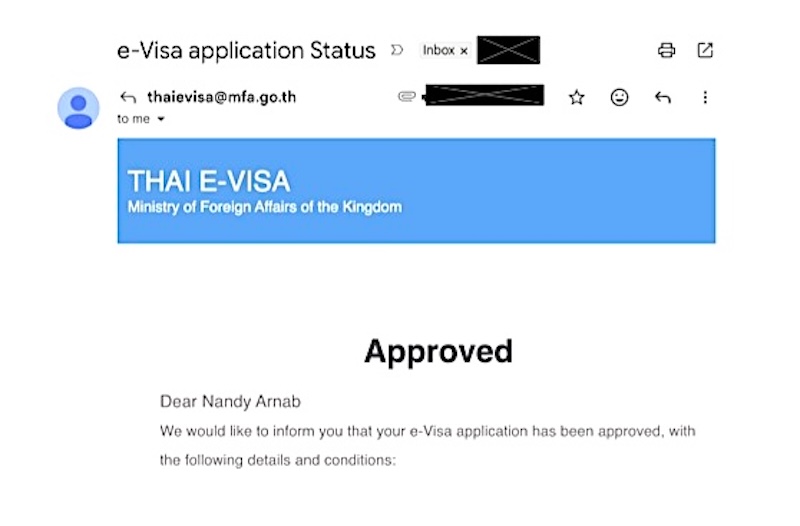
A few days later, an email with the subject “e-Visa application Status” landed in my mailbox. I opened it to find “Approved” written on top.
My five-year multiple-entry DTV was attached.